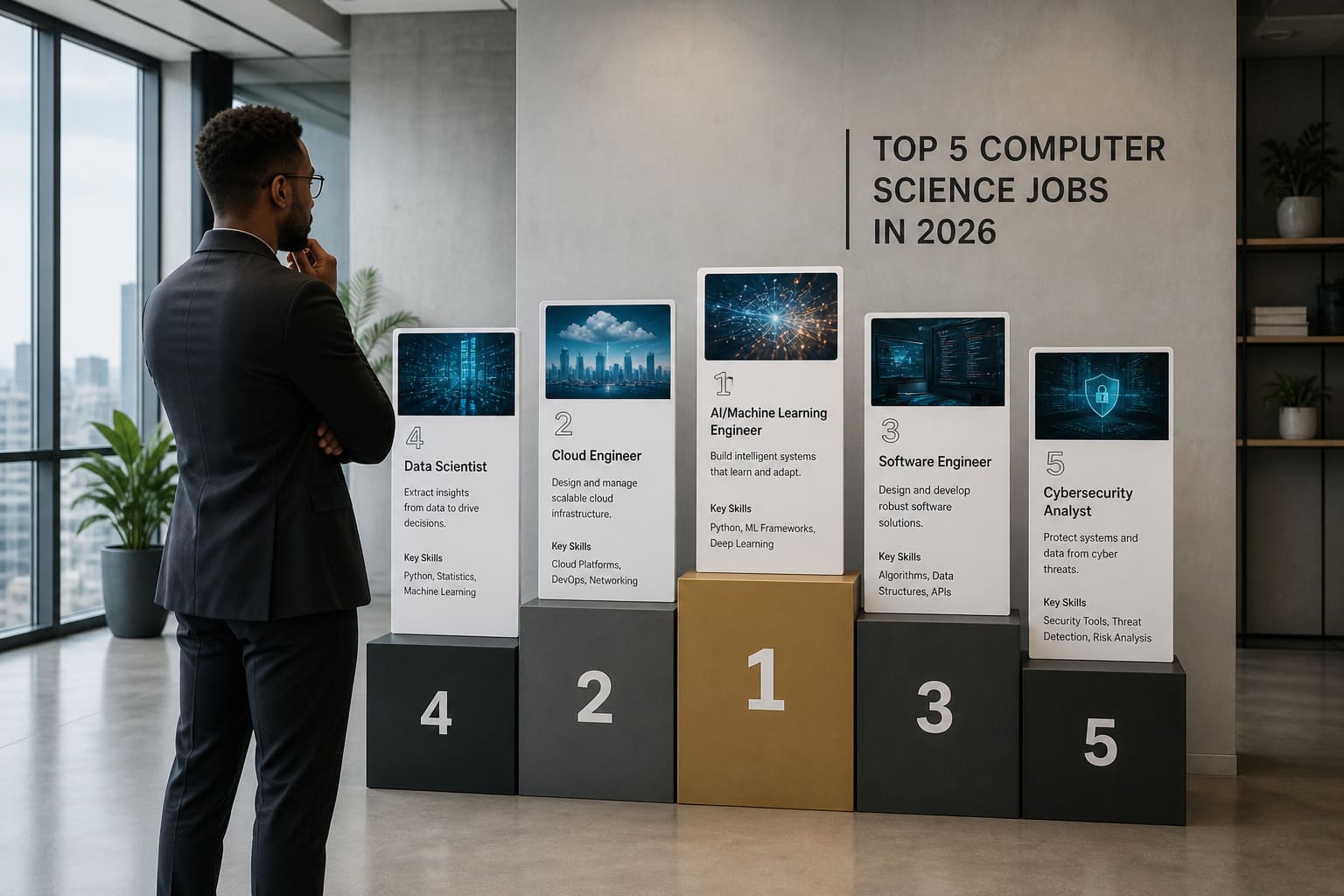
Ranking my top 5 computer science jobs in 2026 — the same list from our TikTok, expanded with what each role actually does and how students can aim for it.
For a wider list, see the longer CS jobs countdown. For learning order, use the CS roadmap.
The Ranking
| Rank | Role |
|---|---|
| 1 | AI & Machine Learning |
| 2 | Software Engineer |
| 3 | Cloud Engineer |
| 4 | Database Engineer |
| 5 | Data Scientist |
1. AI & Machine Learning
The hottest seat in 2026 for a reason: products want smarter search, recommendations, automation, and assistants.
You’ll often work on: models, evaluation, data pipelines for ML, MLOps basics, LLM/app integration.
Build toward it: Python, maths/stats foundations, one end-to-end ML or AI-assisted product demo.
Reality check: Flashy demos ≠ production. Reliability and data quality matter.
2. Software Engineer
Still the backbone. Every AI tool and cloud service still needs people who can design and ship software.
You’ll often work on: features, APIs, testing, code reviews, system design as you grow.
Build toward it: one strong language, Git mastery, clean projects, problem-solving reps.
Related: Top 3 CS tips.
3. Cloud Engineer
Apps live on remote infrastructure. Cloud engineers keep that world running.
You’ll often work on: virtual servers, storage, networking, automation, monitoring, deploys with developers.
Build toward it: Linux, networking basics, one of AWS / Azure / GCP, deploy something real.
Deep dive: Who is a cloud engineer?.
4. Database Engineer
Data has to be stored, modelled, tuned, and kept reliable — or everything above breaks.
You’ll often work on: schemas, query performance, indexing, backups, replication, data integrity.
Build toward it: strong SQL, one relational DB deeply (PostgreSQL/MySQL/etc.), indexing practice, a project with real query pain you fixed.
Pairs well with: backend software roles and analytics teams.
5. Data Scientist
Turning messy data into decisions — forecasts, experiments, insights leadership can use.
You’ll often work on: analysis, stats, visualisation, sometimes lightweight ML.
Build toward it: Python/R, statistics, SQL, storytelling with charts, one portfolio analysis on a real dataset.
Note: Titles vary a lot — always read the job description.
How to Choose Among the Five
| If you like… | Lean toward |
|---|---|
| Models & experimentation | #1 AI/ML or #5 Data Science |
| Building products users touch | #2 Software Engineer |
| Infrastructure & reliability | #3 Cloud Engineer |
| Data modelling & performance | #4 Database Engineer |
You don’t need to lock forever. Many careers move between neighbouring roles.
90-Day Focus Plan
- Pick one rank as your primary lane
- Ship one proof project for that lane
- Learn the complementary skill (e.g. software + Git/deploy, cloud + Linux, data + SQL)
- Publish the write-up — visibility matters (stand-out tips)
FAQ
Is this the only correct ranking?
No — it’s my 2026 ranking based on demand and momentum. Markets and countries differ. Verify local/remote postings yourself.
Where is cybersecurity / DevOps?
Important lanes too — covered more in the wider countdown. This post sticks to the TikTok top five.
Do I need a CS degree for all five?
Helpful, not always mandatory. Portfolio + fundamentals open doors; some employers still prefer formal credentials.
Bottom Line
1 → 5: AI/ML → Software Engineer → Cloud Engineer → Database Engineer → Data Scientist. Pick one, build proof, and keep evolving with the industry.
Original Sen Gideons News Studio editorial — expanded from the @sengideons TikTok. Not career or salary advice.