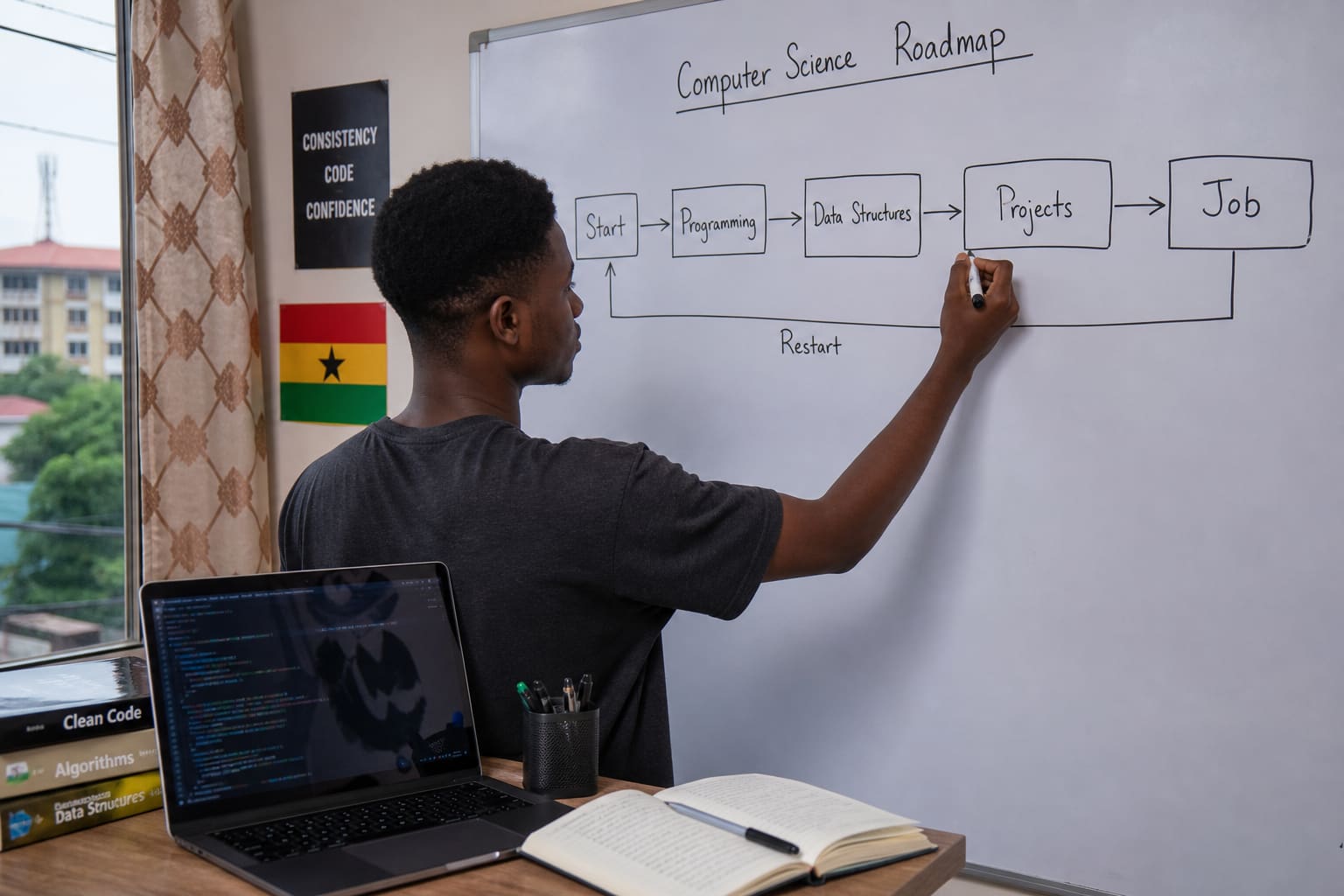
This would be my computer science roadmap if I had to study CS all over again — the same path from our TikTok, expanded into a clear order you can actually follow.
Also useful: Stand out in CS (top 5) · Top 3 CS tips · Should you study CS in 2026? · CS jobs countdown.
Core Foundations (Don’t Skip)
| Pillar | Why it matters |
|---|---|
| Data structures & algorithms | How you store and solve problems efficiently |
| Object-oriented programming | How most large codebases are organised |
| Clean code | Readable work that teammates (and future you) can trust |
| Programming fundamentals | Variables, control flow, functions, testing mindset |
| Problem solving | Breaking big tasks into steps |
| Computational thinking | Patterns, abstraction, decomposition |
| Statistics | Data, ML-lite literacy, smarter decisions |
You don’t need all of these perfectly before step 1 — but treat them as the spine of the journey.
The Roadmap (In Order)
1. Pick a Language and Build Your Foundation
Choose one beginner-friendly language and stick with it for months (Python, Java, JavaScript, C#, etc. — pick what your school or target jobs use).
Goal: write small programs without googling every line.
2. Upgrade Your Core
Level up:
- Functions & modules
- Error handling
- Basic data structures (arrays/lists, maps, stacks/queues)
- Simple algorithms (search, sort, recursion intro)
- Clean naming and small functions
This is where “I can code” becomes “I can structure code.”
3. Computer Architecture
Understand what your code runs on:
- CPU / memory basics
- How programs execute at a high level
- Why performance and memory matter
You don’t need to design chips — you need mental models.
4. Operating Systems
Learn the ideas behind:
- Processes and threads
- Files and memory
- What “the OS is doing” when your app runs
This makes debugging and DevOps less mysterious later.
5. Networking Basics
Enough to be dangerous (in a good way):
- HTTP / HTTPS
- Client vs server
- IP, DNS, ports at a conceptual level
- Why APIs and latency matter
Almost every modern project talks over a network.
6. Start Building Projects
Now apply everything:
- Personal tools, school apps, small products
- Use Git properly
- Deploy something real
- Write READMEs and short case studies
Projects turn roadmap knowledge into proof.
Suggested Timeline (Flexible)
| Phase | Focus |
|---|---|
| Months 1–2 | Language + fundamentals |
| Months 3–4 | DSA + OOP + clean code habits |
| Months 5–6 | Architecture / OS / networking (course-paced) |
| Ongoing | Projects every month — never wait for “done learning” |
School calendars differ. The order matters more than the calendar.
Common Mistakes
- Jumping to 5 frameworks before fundamentals
- Collecting certificates instead of shipping — see projects > certificates
- Skipping Git until “later”
- Trying to master OS and ML in the same weekend
FAQ
Which language should I pick?
Pick one your curriculum or target job stack uses. Switching later is easier once fundamentals click.
Do I need competitive programming on this roadmap?
Helpful for problem-solving muscle — optional intensity. A few problems a week beats none.
Where does AI fit?
Use AI as a tutor and accelerator after you can read and verify code. Don’t outsource understanding.
Bottom Line
Foundations → one language → core upgrades → systems (architecture, OS, networking) → projects. Looking forward to the journey — start at step 1 this week, not “someday.”
Original Sen Gideons News Studio editorial — expanded from the @sengideons TikTok. Not academic advising.